
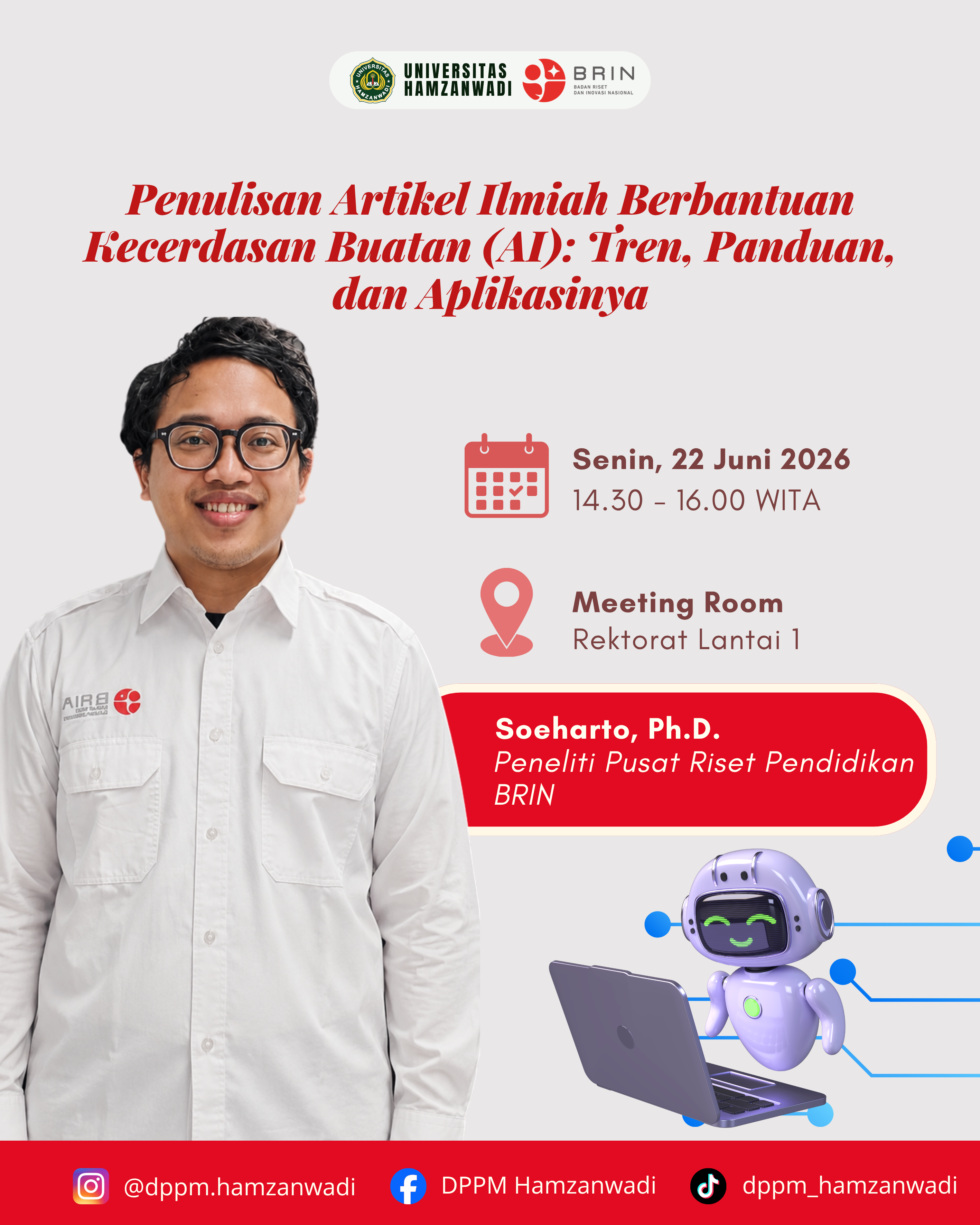
DPPM Universitas Hamzanwadi Hosts Workshop on AI-Assisted Scholarly Article Writing
Pancor, June 22, 2026 — The Directorate of Research and Community Service (DPPM) of Universitas Hamzanwadi organized a workshop entitled "AI-Assisted Scholarly Article Writing: Trends, Guidelines, and Applications." The event featured Soeharto, Ph.D., a researcher at the Research Center for Education of the National Research and Innovation Agency (BRIN), as the keynote speaker. The workshop was conducted as part of the university's efforts to strengthen the capacity of faculty members, researchers, and the broader academic community in understanding recent developments in artificial intelligence technology and its appropriate utilization in the scholarly writing process.
During his presentation, Soeharto, Ph.D. emphasized that AI has currently become a significant instrument capable of supporting academic productivity, ranging from idea generation, article outline development, reference management, language quality enhancement, to the refinement of scientific manuscript structure. Nevertheless, he underscored that the use of AI must remain within the boundaries of academic ethics. AI should not replace the primary role of the author in constructing scientific arguments, conducting analyses, interpreting data, and ensuring the originality and validity of the article's substance.
The speaker also stressed the importance of understanding AI usage policies across various reputable international publishers, such as Elsevier, Springer Nature, and other academic publishing houses. Every author is expected to adhere to principles of transparency, academic accountability, plagiarism avoidance, and clarity regarding human contribution within the scholarly manuscript. Through this activity, the DPPM of Universitas Hamzanwadi anticipates that participants will be able to utilize AI wisely, ethically, and productively to enhance the quality of scientific publications, while simultaneously upholding academic integrity in every work produced.
In addition to addressing ethical considerations, the speaker introduced several types of AI technologies that can be leveraged to facilitate the scholarly writing process. These include generative AI tools such as ChatGPT, Gemini, Claude, and Microsoft Copilot, which can assist in developing ideas, refining writing structure, and improving the clarity of academic language. Furthermore, there are AI-based platforms for literature searching and reference mapping, including Elicit, Perplexity, Scite, Semantic Scholar, and Connected Papers. To support language quality and writing mechanics, researchers may also utilize applications such as Grammarly, QuillBot, or DeepL Write. Nonetheless, it was emphasized that all such AI applications must be positioned as assistive tools, rather than substitutes for the author's academic responsibility in ensuring data validity, reference accuracy, originality of ideas, and overall scholarly integrity.